
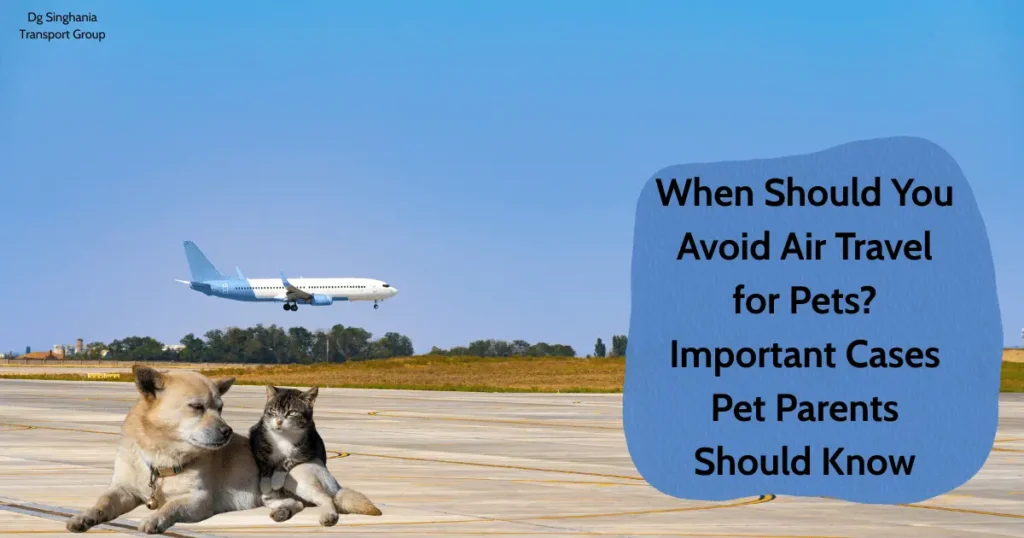
Air travel can be the right option in some relocations, especially when distance is long and time is limited. But flight is not automatically the safest choice for every pet. In India, airline rules also vary a lot: Air India and Akasa currently allow pet travel under their own conditions, while IndiGo generally does not allow pets on board except guide dogs.
For many pet parents, the real question is not just, “Can my pet fly?”
It is: “Should my pet fly in this case?”
That is a much better question, because some pets and some situations need more caution than others. This guide explains the important cases where air travel should be avoided, postponed, or chosen only after proper veterinary and airline clearance.
Quick Answer: When Should You Avoid Air Travel for Pets?
Air travel is usually worth avoiding or reconsidering when your pet:
- has breathing risk, especially if it is a short-nosed / brachycephalic breed
- is ill, recovering, dehydrated, weak, or not clearly fit to fly
- is too young or not old enough for the airline’s minimum age requirement
- is pregnant or has recently given birth
- would need sedation just to get through the flight
- is likely to struggle badly with extreme heat, stress, or long airport handling
- does not meet the airline’s documentation, size, route, or policy requirements
In simple words: air should not be chosen just because it is fast. If the pet’s condition, breed, age, behaviour, or route conditions make flying harder or riskier, another mode may be the better decision.
1. Avoid Air Travel for Short-Nosed Breeds Unless the Case Is Carefully Assessed
This is one of the most important caution areas.
The AVMA says brachycephalic pets such as Pugs, Persians, and other short-nosed breeds are at higher risk of overheating and breathing problems during travel, especially by air. USDA APHIS gives the same warning and says extra care is required with many short-nosed dogs and cats because stress and heat can increase risk. IATA’s operator-variation guidance also notes that brachycephalic dog and cat breeds may be restricted from transport in cargo holds.
So if your pet is a Pug, French Bulldog, English Bulldog, Boxer, Persian, Himalayan, or a similar short-nosed breed, air travel should never be treated casually. In many such cases, a slower but more controlled journey may be safer.
2. Avoid Air Travel if the Pet Is Sick, Recovering, Weak, or Not Clearly Fit to Fly
Air travel is not a good idea when the pet is already physically stressed.
Air India requires a health certificate from a registered veterinarian stating that the pet is fit to travel by air, and Akasa similarly requires a validated health certificate from a registered vet. Airline and veterinary guidance both point in the same direction: if the animal is not fit, the journey should not go ahead as planned.
Practically, this means you should be extra careful if your pet has:
- fever
- breathing trouble
- recent surgery
- vomiting or diarrhea
- dehydration
- weakness
- recent illness or recovery
Yahan speed se zyada important hota hai stability. If the pet is already struggling, flying is usually the wrong moment to “try and manage it.”
3. Avoid Air Travel for Very Young Pets
Very young pets deserve extra caution.
USDA APHIS says dogs and cats should be at least 8 weeks old and fully weaned before air travel. Airline rules in India may be stricter depending on the carrier and where the pet is traveling: Air India says pets must be at least 8 weeks old for cabin travel and 3 months old for cargo hold travel, while Akasa says dogs and cats must be at least 3 months old on the date of travel.
So if the pet is still very young, recently weaned, or not yet physically stable enough for the airport-and-flight environment, air travel is usually something to avoid rather than rush into.
4. Avoid Air Travel if the Pet Is Pregnant or Has Recently Given Birth
Pregnancy is another major caution point.
Akasa’s conditions say pregnant pets of more than 4 weeks will not be carried on its aircraft. Air India’s pet guidelines say pregnant pets and pets that have given birth in the last 48 hours are not allowed.
So if your pet is pregnant, suspected to be pregnant, or has recently delivered, air travel should be avoided unless there is a very specific, veterinarian-supported reason and the airline’s rules clearly allow it.
5. Avoid Air Travel in Extreme Heat or Harsh Weather Windows
Even when the flight itself is pressurized, the pet still has to move through ground handling, loading, unloading, holding areas, and airport exposure.
USDA APHIS says dogs and cats and their kennels should be protected from extreme temperatures and notes they must not be exposed to ambient air temperatures above 85°F / 29.5°C or below 45°F / 7.2°C beyond specified limits during handling and movement. The AVMA also advises checking airline restrictions related to weather conditions and time of year.
In simple terms: if the route involves peak summer heat, hot tarmac exposure, or difficult midday handling, that is a strong reason to pause and reassess. Especially for sensitive pets, summer flight available hai does not automatically mean summer flight suitable bhi hai.
6. Avoid Air Travel if You Are Planning to Sedate the Pet Just to Make the Flight Possible
This is a very important point.
IATA says sedation or tranquilization is generally not recommended for pets in transit, and advises against sedating dogs or cats for air travel except under veterinary direction for valid medical reasons. The AVMA also warns that tranquilizers or sedatives can increase the risk of heart or respiratory problems during air travel.
So if the only way the flight feels “possible” is by heavily calming the pet with medication, that is usually a sign to step back and rethink the mode of transport. Sedation should never be used casually as a workaround for poor travel suitability.
7. Avoid Air Travel if the Pet’s Temperament Is Clearly Unsuitable
Not every pet handles flying well.
USDA APHIS says dogs and cats traveling by air should be well behaved and non-aggressive. IATA also notes that animals can become stressed and aggressive during air travel, even animals from the same household.
This matters a lot in real life. If a pet:
- panics badly in carriers
- cannot stay settled in enclosed spaces
- becomes reactive under unfamiliar stress
- shows strong separation distress
- becomes aggressive when handled by strangers
then air may not be the best first option. In these cases, a more supervised and adjustable journey is often worth considering.
8. Avoid Air Travel if Airline Rules, Route Rules, or Weight Rules Don’t Fit the Pet
Sometimes the issue is not the pet’s health but the travel framework itself.
For example, Air India allows in-cabin pet travel only up to a 10 kg combined pet-and-carrier weight, with heavier pets moving to baggage/cargo rules, and it does not allow pets on nonstop flights between India and the United States except certified service dogs. Akasa has its own rules, including minimum age and documentation windows. IndiGo generally does not permit pets other than guide dogs.
So if your pet does not fit the airline’s size, age, route, or document requirements, the safest choice is not to “manage somehow.” It is to choose a more suitable plan.
9. Avoid Air Travel if the Documents and Vet Clearance Are Not Properly Ready
Paperwork is not a small detail in air pet travel.
Air India asks for a vaccination record or pet passport, valid health and rabies certificates from a registered veterinarian, and original documents for verification. Akasa requires validated vaccination and health certificates from a registered vet, obtained within 72 hours of travel.
If your documents are incomplete, mismatched, outdated, or not issued in the required time window, air travel should be postponed rather than risk last-minute rejection at the airport.
What to Do Instead if Air Travel Is Not the Right Choice
If air is not suitable, that does not mean relocation is impossible.
It simply means the journey should be planned differently.
In many cases, better alternatives may include:
- a more controlled road journey
- a calmer train-based plan
- postponing the move until the pet is medically or practically ready
- completing vet checks and travel preparation first
The goal is not to force one mode. The goal is to choose the one that is fairest to the pet.
Our View: Flight Should Be Chosen Only When It Truly Suits the Pet
At Singhania Pet Relocation, we do not believe air travel is the premium option just because it is faster.
In some cases, yes, flying makes sense. But in other cases, it creates avoidable stress or risk.
The better approach is to ask:
- Is the pet healthy enough?
- Is the breed suitable?
- Is the weather manageable?
- Are the documents ready?
- Does the airline actually allow and support this journey properly?
If the answer is weak on any of those points, air travel may not be the right call.
Final Thought
Air travel can work well for some pets. But it should usually be avoided, delayed, or reconsidered when the pet is too young, pregnant, medically unfit, heavily stress-prone, short-nosed, or likely to need sedation just to get through the journey. Airline restrictions, heat exposure, route limitations, and missing paperwork are also valid reasons to choose another plan.
In simple words:
fastest option har baar safest option nahi hota.
The right travel mode is the one your pet can handle safely and fairly.
Frequently Asked Questions
Are short-nosed breeds safe for air travel?
They need extra caution. The AVMA and USDA APHIS both warn that short-nosed pets are at higher risk of overheating and breathing problems during air travel, especially under stress or heat.
Can I sedate my pet for a flight?
Not casually. IATA and the AVMA both advise against routine sedation for air travel unless it is specifically directed by a veterinarian for a valid medical reason.
What if my pet is very young?
Minimum age rules apply. USDA APHIS says dogs and cats should be at least 8 weeks old and fully weaned for air travel, while airline policies may be stricter depending on the carrier.
Do all Indian airlines allow pets?
No. Air India and Akasa allow pet travel under their own rules, while IndiGo generally does not allow pets other than guide dogs.
Should I fly my pet in summer?
That depends on the pet, route, and handling conditions. Extreme heat is a known risk factor during air-transport handling, especially for sensitive pets and brachycephalic breeds.
Not sure whether air travel is the right option for your pet?
Share your route, pet breed, age, and travel timeline, and we’ll help you assess whether flight is suitable or whether another mode would be safer.